HandUMI: A modular, robot-free capture system for bimanual arms
Collect natural demonstrations with human hands, preserve the raw motion and sensor record, then calibrate and retarget the same episodes to different parallel-jaw robots.
Abstract
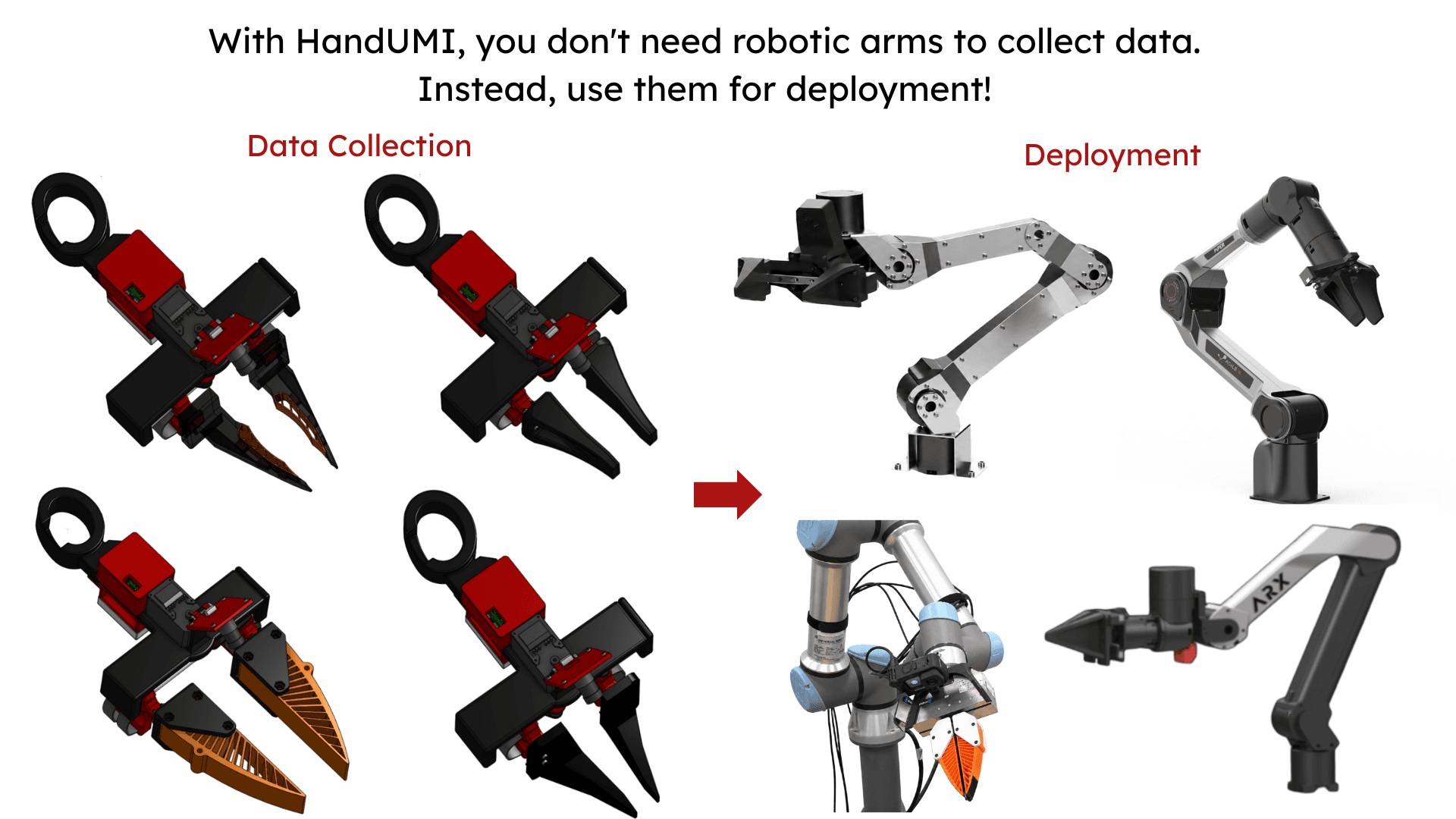
Robot learning needs demonstrations from many tasks, objects, and environments, yet conventional teleoperation keeps both a robot and a trained operator inside every collection loop. HandUMI moves the interface onto the operator instead. A worn pair of parallel jaws follows natural pinching; VR controllers provide six-degree-of-freedom wrist poses, wrist cameras record the visual observation, and a servo encoder reports aperture. Detachable fingertips adapt the interface to the gripper geometry of the target arm.
The accompanying software records these asynchronous streams against a shared target time, retains source timestamps and health metadata, validates each episode, and stores a LeRobot-compatible raw dataset. Robot geometry is applied only during conversion or replay, allowing one accepted recording to be tested against multiple supported bimanual embodiments. The current public release targets fixed-base manipulators with one parallel gripper per side.
01 / Motivation
Why robot-free capture
The robot is valuable at deployment. It should not also be the scarce instrument that every demonstration depends on.
A conventional bimanual leader–follower setup consumes two follower arms and either two leader arms or a VR control rig. Every additional collector still needs access to the physical deployment system, its workspace, and its safety envelope. Moving to another room or site means moving the robot too.
HandUMI separates capture from execution. The human supplies the dexterity and task context; compact wearable hardware records the trajectory and observation; the robot re-enters only after the episode has passed quality checks and kinematic review. This changes the scaling unit from a robot cell to a wearable pair. The separation builds on the original Universal Manipulation Interface, which made portable capture and deployment-time retargeting distinct stages.[8]Universal Manipulation Interface: In-The-Wild Robot Teaching Without In-The-Wild RobotsCheng Chi, Zhenjia Xu, Chuer Pan, Eric Cousineau, Benjamin Burchfiel, Siyuan Feng, Russ Tedrake, and Shuran Song; Robotics: Science and Systems, 2024.
02 / Architecture
Capture first. Choose the robot later.
The core design decision is to keep the raw capture robot-agnostic. Controller poses, physical jaw widths, camera frames, calibration identities, source timing, and health flags are recorded before a target kinematic model is chosen. A robot profile then supplies TCP frames, joint ordering, limits, inverse-kinematics weights, gripper mapping, and—when available—a measured table-to-robot transform.[2]HandUMI software repositoryApache-2.0 recorder, validation, conversion, replay, robot profiles, tests, and documentation; source snapshot fd0be87, 20 August 2026.
- 01DemonstrateNatural bimanual motion
- 02SynchronizePose, aperture, and video
- 03ValidateTracking, timing, and continuity
- 04RetargetCalibration plus robot profile
- 05PreviewSimulation before hardware
Design invariant
A new robot integration may add assets, calibration, and a hardware backend. It does not change the recorder or the raw capture format.
03 / Hardware
A gripper worn as an instrument
HandUMI mounts across the thumb and index/middle fingers. The operator opens and closes the jaws through an ordinary pinch, retaining direct cutaneous and kinesthetic feedback instead of commanding a remote trigger. The structural body, camera mount, encoder actuation, and controller support remain fixed; only the contact tip changes for a new parallel-jaw gripper.[1]HandUMI hardware repositoryApache-2.0 CAD, bill of materials, assembly files, and calibration resources; source snapshot e58de33, 20 August 2026.
- PoseVR tracking
- PICO 4 Ultra or Meta Quest 3 controllers supply wrist pose in a shared headset world frame.
- ApertureDirect sensing
- A Feetech servo encoder records the mechanical opening rather than estimating width from wrist-camera markers.
- ObservationWrist RGB
- A compact UVC fisheye camera stays task-facing while the VR system handles motion tracking.
- ContactSwappable tips
- Published CAD covers AgileX PiPER, ARX X5 2023, Dream Gripper, Trossen WidowX AI, and the original UMI gripper.
Reference bill of materials
At the current published prices, mechanical and structural parts total $14.88 and electronics total $94.98, for $109.86 per unit or $219.72 per bimanual pair. These are early reference estimates: they exclude the shared headset, workstation, shipping, taxes, assembly labor, and calibration time.
| Part | Quantity | Listing price | Source | Unit total |
|---|---|---|---|---|
| Mechanical and structural | ||||
| PLA filament | 0.2 kg | $12.59 / kg | Amazon ↗ | $2.52 |
| Rolling bearing | 4 | $13.29 / 20 pcs | Amazon ↗ | $2.66 |
| Linear bearing | 4 | $7.49 / 4 pcs | Amazon ↗ | $7.49 |
| Axle (135 mm) | 1 rod | $11.99 / 10 pcs | Amazon ↗ | $1.20 |
| M3 hardware kit (750 pcs) | 5 total: 1 × M3×20, 2 × M3×12, 2 × M3×15 | $9.99 / 750 pcs | Amazon ↗ | $0.07 |
| Velcro tape | 4 | $13.99 / 75 pcs | Walmart ↗ | $0.75 |
| M2 hardware kit (660 pcs) | 16 total: 8 screws and 8 nuts | $7.99 / 660 pcs | Amazon ↗ | $0.19 |
| Mechanical and structural subtotal | $14.88 | |||
| Electronics | ||||
| Fisheye USB camera | 1 | $56.99 | Amazon ↗ | $56.99 |
| Feetech servomotor | 1 | $13.89 | Alibaba ↗ | $13.89 |
| Power supply | 1 | $10.00 | Amazon ↗ | $10.00 |
| Feetech servo controller | 1 | $10.60 | Amazon ↗ | $10.60 |
| USB-C cable | 1 | $7.00 / 2 pcs | Amazon ↗ | $3.50 |
| Electronics subtotal | $94.98 | |||
| Grand total, one unit | $109.86 | |||
| Bimanual pair | $219.72 | |||
Listing prices are normalized by pack quantity; each row’s total is the amount allocated to one HandUMI unit. Prices and availability can change by region.
04 / Software
A traceable data lifecycle
The recorder aligns every row to one shared target timestamp. Camera, tracker, and aperture samples retain their own source times and health state, so short failures remain inspectable rather than being silently replaced. Sustained tracking, camera, or encoder loss discards the episode. A strict validator checks duration, synchronization, frozen signals, motion jumps, and invalid state before conversion.[4]HandUMI technical documentationRecording and validation reference for synchronization, source timestamps, health flags, strict episode checks, and the LeRobot-compatible dataset layout.
handumi doctor --device meta
handumi record --output-dir outputs/handumi-demo
handumi validate outputs/handumi-demo --strict
handumi replay outputs/handumi-demo --robot openarmv1
Captures use a LeRobot v3-compatible layout. Wrist and workspace video, controller pose, gripper width, sensor health, calibration hashes, and coordinate conventions travel together. Conversion creates a target-specific derivative and leaves the robot-agnostic source intact. Controller-to-TCP calibration is selected from an explicit file, an identity-bound dataset snapshot, the robot/device profile, or a documented legacy fallback—in that order.
05 / Current evidence
What the public release supports today
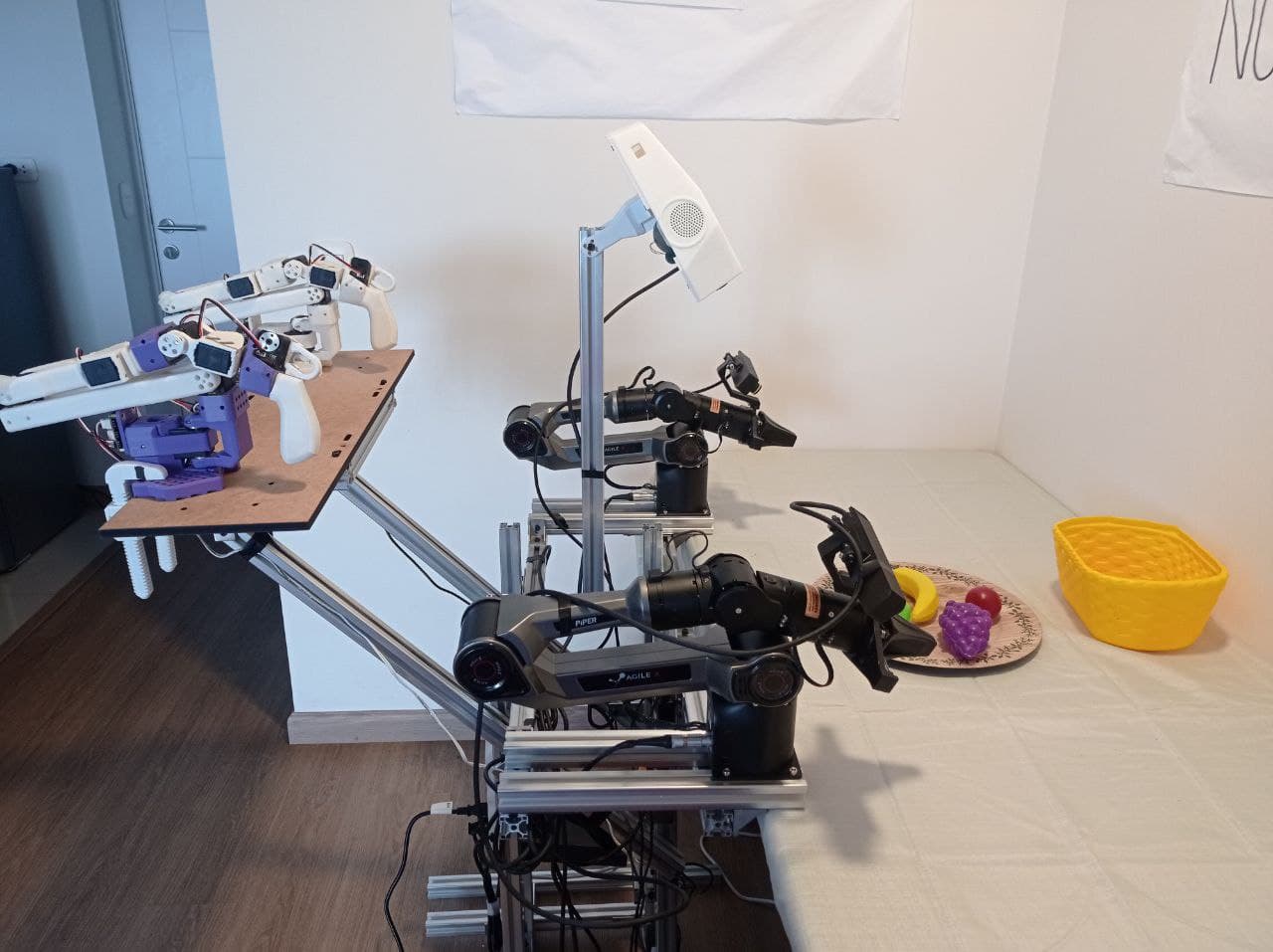
The software ships simulation models for AgileX PiPER, OpenArm, TRLC-DK1, Axol, and I2RT YAM. PiPER and OpenArm also have real-robot teleoperation backends. The remaining entries are replay/simulation integrations unless their repository documentation states otherwise.
- Capture
- PICO + Meta QuestXRoboToolkit or the Quest compatibility app
- Simulation
- 5 robot modelsOne profile interface for replay and conversion
- Physical control
- 2 backendsAgileX PiPER and OpenArm
Published replay diagnostics
The repository documents target-specific replay on recorded validation episodes. The numbers below measure inverse- kinematics agreement in simulation under provisional table transforms; they are not external measurements of physical TCP accuracy and are not robot policy success rates.
| Target | Episodes | Maximum position error | Status |
|---|---|---|---|
| OpenArm v1 | 3 | 2.92–4.71 cm | 1 pass; 2 require review |
| TRLC-DK1 | 1 | 0.22 cm | Simulation replay |
| Axol | 3 | 0.38–2.72 cm | 3 strict-IK passes |
Orientation error and configuration details remain essential: for example, the documented TRLC-DK1 replay reports 22.19° maximum orientation error even with low position error. Full diagnostics are in the replay guide.
06 / Claims boundary
Scope and limitations
Fixed-base bimanual scope. The current implementation guide covers two-arm robots with one TCP and one parallel gripper per side. Mobile-base and humanoid retargeting remain research directions, not current support claims.
Capture portability is not policy transfer.A raw episode can be evaluated against multiple robot profiles, but physical execution still depends on calibration, reachability, collision checks, controller limits, and task-specific policy validation.
Direct sensing is not a precision result.The encoder removes visual aperture estimation from the pipeline; physical width accuracy, hysteresis, TCP error, and synchronization still require external measurement.
The cost is a BOM boundary. Published totals cover listed parts only and should not be read as a replicated build cost, an operating cost, or a measured comparison with teleoperation.
Safety
Simulation preview does not authorize physical execution. Before commanding a robot, validate the trajectory, enforce joint, velocity, acceleration, workspace, and collision limits, and keep an emergency stop accessible.
07 / Availability
Inspect it. Build it. Extend it.
The HandUMI hardware and core software are released under Apache 2.0. The public repositories include printable STL and editable STEP files, the bill of materials, calibration and quality tooling, robot profiles, tests, and documentation. New fixed-base parallel-jaw embodiments can be added without changing the recorder.
Meta Quest support is provided through a separate public Unity compatibility project reconstructed from the YubiQuestApp APK. It is an independent, best-effort behavioral reconstruction, not recovered original source. The repository does not currently include a license file, so this paper does not label that app itself as open source.[3]HandUMI Quest App v0.2.1Public Unity compatibility-source snapshot 1597c24, 13 July 2026; an independent behavioral reconstruction with no license file in the current repository.
References & provenance
Primary sources
- [1]
HandUMI hardware repository, Apache 2.0, snapshot e58de33, 20 August 2026.
- [2]
HandUMI software repository, Apache 2.0, snapshot fd0be87, 20 August 2026.
- [3]
HandUMI Quest App v0.2.1, compatibility-source snapshot 1597c24, 13 July 2026.
- [4]
HandUMI technical documentation, recording, validation, calibration, replay, and embodiment integration guides.
- [5]
Hardware announcement and USB-C insertion demonstration, 7 July 2026; earlier cost figures are superseded here by the current BOM.
- [6]
Real-robot teleoperation test, 12 July 2026.
- [7]
Multi-embodiment retargeting thread, 18 July 2026; includes the calibration, raw/converted comparison, and OpenArm execution clips.
- [8]
Chi, C., Xu, Z., Pan, C., Cousineau, E., Burchfiel, B., Feng, S., Tedrake, R., and Song, S. Universal Manipulation Interface: In-The-Wild Robot Teaching Without In-The-Wild Robots. Robotics: Science and Systems, 2024.